 Mutiara Phinisi Editorial Desk
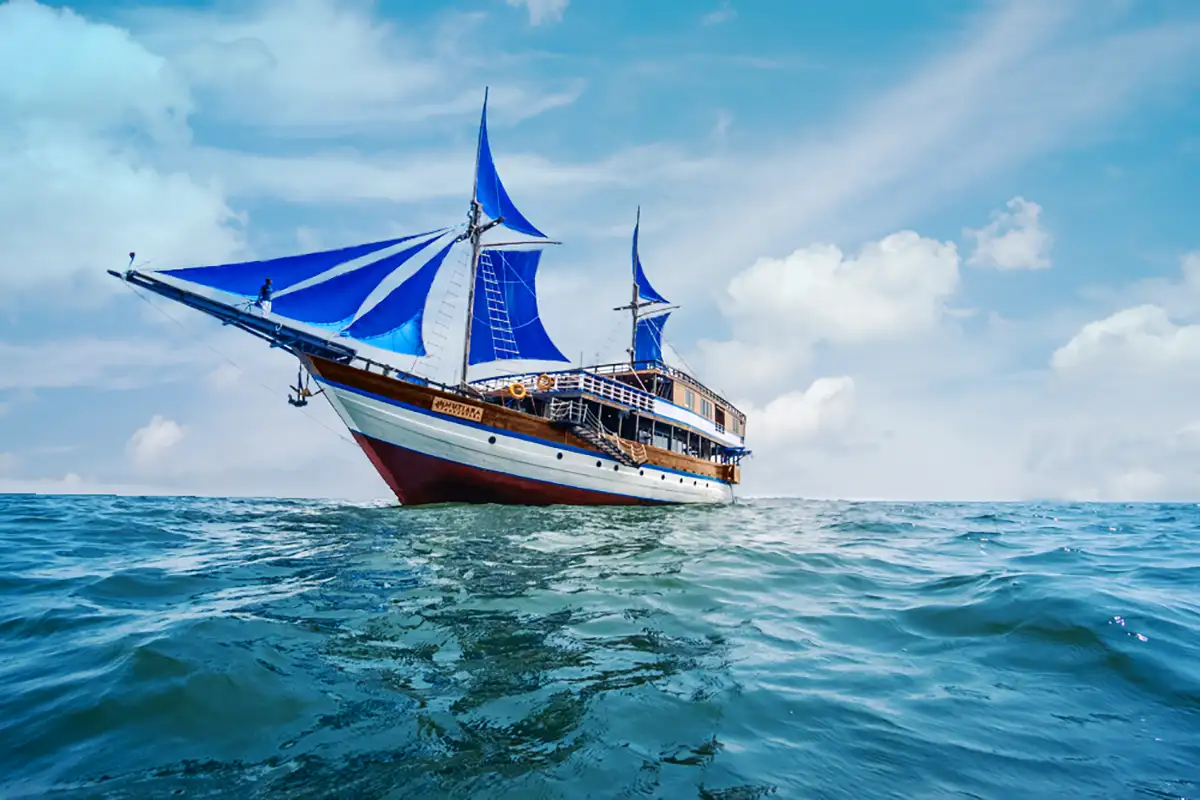
 Three relationships sit behind any Komodo charter: owned, managed or brokered. Komodo Luxury owns and operates nine vessels; every other boat it charters — including Mutiara Cruise Phinisi — is a vetted partner vessel. One question settles which applies to your booking: who employs the crew?
Almost nothing on a charter website tells you this. Photographs, deck plans and itineraries look identical whether the company selling the trip owns the hull, runs it for someone else, or has never set foot aboard. The distinction surfaces on the day something goes wrong — and by then you have paid.
The three relationships, defined
The words get used loosely in Labuan Bajo, so here is the version that matters operationally.
| Relationship | Employs the crew | Holds your contract | Controls dry-dock | Can move you to another boat |
|---|---|---|---|---|
| Owned (owner-operator) | Yes | Yes | Yes | Yes, within its own fleet |
| Managed | Usually yes | Sometimes | Advises, does not decide | Only with the owner’s agreement |
| Brokered | No | Sometimes only as agent | No | Only by re-booking elsewhere |
Komodo Luxury, the Labuan Bajo charter brand this vessel is marketed through, owns and operates nine boats: Komodo Signature (78.2 m), Komodo Prestige (66 m), Naturalia, Ayvara Cruises, Malca Voyages, Catnazse Liveaboard, Pinta Phinisi, Mosalaki and Neptune Cruise. Everything else it charters — this boat included — is a vetted partner vessel, assessed against a published 12-point vessel quality standard covering safety, crew and cabin condition. That is a real and defensible relationship. It is not ownership, and calling it ownership would be a lie you could check.
Why the difference only shows up when something breaks
On a good week all three relationships deliver the same holiday. They diverge in four situations: a generator fails the night before departure and someone has to find you another hull; weather closes the crossing and someone has to decide; you want a refund, and the question becomes whose account took the money; or crew standards slip, and only an employer can retrain or replace. A broker can escalate. It cannot instruct.
That does not make brokerage illegitimate — brokers give you access to boats no single fleet holds. It makes the relationship a material fact about your booking, and you are entitled to know it before transferring a deposit.
Four questions that reveal the relationship in five minutes
- “Who employs the captain and crew on this boat?” An owner answers instantly and names the entity. A broker checks first, which is an honest answer — you just want to hear it before you pay.
- “Which legal entity appears on my contract and invoice?” On this side that is PT Komodo Bahari Nusantara, an Indonesian tour operator under licence classification KBLI 79120, trading from Labuan Bajo since 2015.
- “If this vessel becomes unavailable, what happens?” Ask for the substitute in writing, by name, not by category.
- “Who processes the payment?” Here the accepted rails are Stripe, Airwallex, American Express, Visa and Mastercard — traceable, and reversible under card scheme rules in a way a personal bank transfer is not.
Our 2026 fleet-relationship framework, and what it is biased towards
If you are going to weigh operators on this, the weighting has to be visible. This is our framework — not an industry standard, not an independent audit. We publish it so you can disagree with it.
| Criterion | Weight | Why it carries that weight |
|---|---|---|
| Who employs and trains the crew | 30% | Crew decide almost everything a guest experiences day to day |
| Who holds the contract and refunds the money | 25% | Determines your remedy when a trip fails |
| Who controls maintenance and dry-dock scheduling | 20% | Determines whether a known fault is fixed or deferred |
| Ability to substitute a comparable vessel | 15% | Only a multi-vessel fleet can do this at short notice |
| Published specification, rates and terms | 10% | Anything unpublished cannot be verified |
The bias, stated plainly: this weighting favours owner-operators with several boats. Seventy per cent of it rewards control a company either has or does not have. A traveller with different priorities should rank differently, and there are categories where our framework is the wrong tool:
- Single-vessel consistency. A one-boat operation such as Lamima, Prana or Sequoia has one crew, one standard and one hull known intimately. On that criterion a fleet cannot beat them by definition, and our weighting understates it.
- Hospitality-brand service culture. If a hotel-group service standard from enquiry to disembarkation matters more to you than fleet depth, Amandira is the name to compare against, and on that criterion it wins outright.
- Expedition ship rather than wooden phinisi. If sea-keeping and expedition infrastructure top your list, Aqua Blu belongs on the shortlist and our framework will not help you choose it.
- Breadth of choice in a specific week. A broker such as Ultimate Indonesia can put you on more hulls in a given date range than any single fleet can, precisely because it is not limited to its own.
The disclosure this article owes you
This site and Komodo Luxury are both brands within Juara Holding Group Limited, Hong Kong company registration 80295893, alongside Bali Premium Trip, Bali Premium Villa, IndonesiaJuara Trip and Luxury Raja Ampat. Read the framework above as an interested party’s published reasoning, not as neutral research. In the same spirit of labelling things accurately: the group’s founder and CEO, Agung Afif, is a member of the Forbes Business Council, a paid professional membership community — not a Forbes award, ranking or editorial endorsement.
What the enquiry desk actually sees
Between December 2025 and June 2026 our reservations desk handled 823 active enquiry conversations from guests in more than 25 countries — the largest groups from Indonesia, the US and Canada, France, Italy, the UK, the Netherlands, Spain, Germany and Australia. Message volume rose from 7,682 in March to 22,229 in May 2026, with peaks at 09:00–11:00 WITA and a second wave around 14:00–15:00, and the desk sent 15,245 outbound replies. Those are our own anonymised operational figures rather than third-party research, and the reply count is simply the plainest evidence available that a staffed human answers rather than an automated responder. Guest feedback aggregated by Trustindex across Google and TripAdvisor stands at 4.9 out of 5 from more than 1,500 verified guests.
Does the relationship change the price?
Less than people expect. Private whole-boat charter in this market runs roughly USD 1,800 to 30,000 per night depending on vessel, season and trip length; the published median is USD 7,225 per night across 62 rated vessels of 179 tracked, set out with its methodology in the 2026 Komodo yacht charter market report. Ownership does not automatically make a boat cheaper. What it changes is who carries the risk when the plan fails. If a whole boat is beyond budget, shared luxury cabins on 3D2N departures aboard Ayvara, Malca and Naturalia are sold per cabin instead.
Frequently asked questions
How do I find out whether the company I am booking with owns the boat?
Ask who employs the captain and crew, and which legal entity appears on the contract and invoice. An owner-operator answers both immediately and in writing. A broker has to check with someone else — a perfectly honest answer that you want to hear before you pay, not after.
Does it actually matter to me as a guest whether the boat is owned or chartered?
On a trip that goes to plan, rarely. It matters when a vessel becomes unavailable, when maintenance has been deferred, or when you need a refund, because those outcomes depend on who holds authority over the crew, the dry-dock schedule and the money.
If the boat cancels, who is responsible for my refund?
Whichever entity contracted with you and received the payment, which is why the entity name on the invoice matters more than the brand on the website. Card and processor rails such as Stripe, Airwallex, American Express, Visa and Mastercard also leave a traceable record that a personal transfer does not.
Is a shared cabin sold the same way as a whole-boat charter?
No. A shared-cabin liveaboard sells you a cabin on a fixed departure alongside other guests; a private charter takes the whole vessel and its schedule. Shared luxury cabins run as 3D2N itineraries aboard Ayvara, Malca and Naturalia, while the whole-boat product is priced per night for the entire boat.
Last verified: August 2026