 Mutiara Phinisi Editorial Desk
 Booking directly with the operator gets you the published rate card, the actual cancellation terms and a contract with whoever runs the vessel. An agent or OTA adds a layer of margin and, more importantly, a layer between you and the crew. Neither is automatically wrong — but you should know which one you are doing.
The three things you are actually choosing between
| Route | Who holds the contract | Price structure | Who answers on the day |
|---|---|---|---|
| Direct with the operator | The company that charters and runs the vessel | Published rate card | The reservations desk that talks to the captain |
| Local agent in Labuan Bajo | The agent, who then books the boat | Rate card plus agent margin | The agent, who then calls the operator |
| Online travel platform | The platform, under platform terms | Rate plus platform commission, often 15–25% in the industry generally | Platform support, usually not local |
The commission range above is a general industry figure, not a number any specific platform publishes for this vessel — treat it as an order of magnitude rather than a quote. What is not in doubt is the direction: every intermediary is paid from somewhere, and on a charter that somewhere is your invoice.
The test that actually separates them
Forget who has the nicer website. Ask four questions and see who can answer without checking:
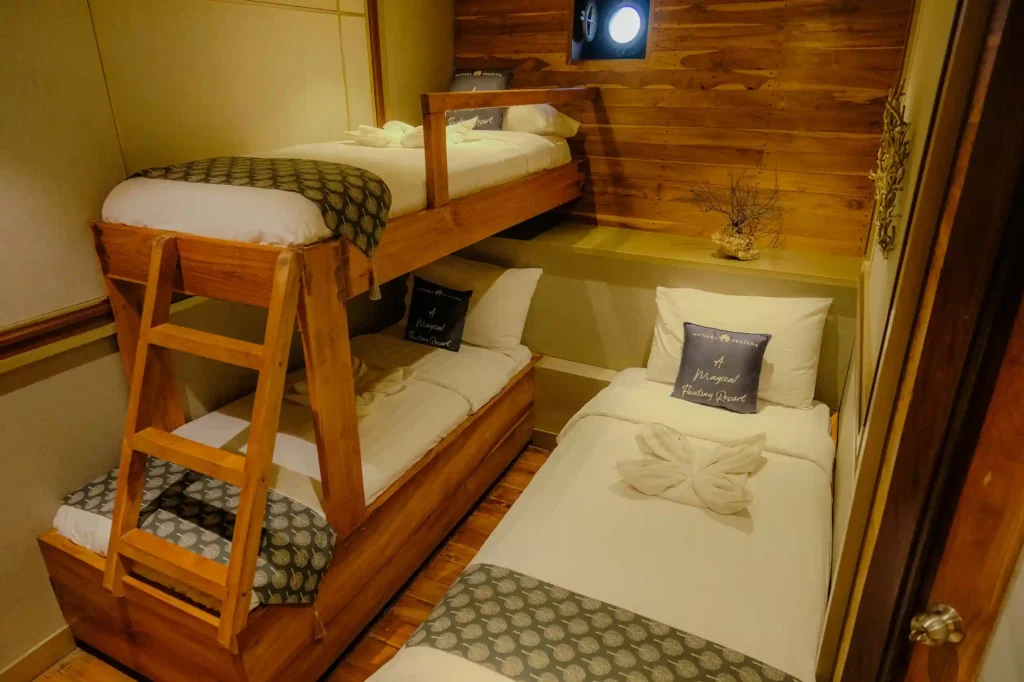
- How many cabins, in which configurations, and how many berths do they add up to? On this vessel the honest answer is ten cabins in five types totalling 26 berths against a published maximum of 28 guests, with the last two places on extra bedding.
- What is the main engine and what is the generator set? Nissan RF10, ten cylinders, 440 PS; Mitsubishi 60 KVA and 40 KVA, three-phase.
- Is a BCD included with the dive package? No — tanks, guide at 1:4, weights, hooks and a night torch are; BCD, regulator, computer and nitrox are not.
- What happens to my deposit if a storm cancels the trip? The published force majeure position provides no refund.
Someone selling the vessel has those answers. Someone reselling a listing goes away and comes back. That gap is not a moral failing — it is simply information distance, and information distance is what costs you when something needs deciding at short notice.

Where an agent genuinely earns their margin
This is not a one-sided argument. A good local agent is worth paying when you are assembling a multi-part trip — flights into Labuan Bajo, hotel nights either side, land transfers, a Flores extension — and want one person accountable for the joins. They also help when there is a language barrier, or when a group needs someone on the ground in Labuan Bajo on the morning of departure.
What an agent cannot do is change the vessel’s terms. The 50% deposit, the balance at 30 days, the non-refundable deposit and the no-reschedule rule come from the operator regardless of who sells the trip. If an intermediary offers softer terms than the published cancellation policy, ask in writing who is standing behind that promise.
The published-price test
There is a simple proxy for how confident a seller is: do they publish numbers? A useful comparison, scanned on 1 August 2026 — komodotouristic.com publishes per-person prices down to the cent (USD 271.57 for a shared 3D2N), AYANA publishes Lako di’a suites at Rp 44,888,000++ and Rp 56,700,000++ per night, and phinisitrip.com publishes IDR 6,000,000–8,350,000 per person for shared 4D3N. Meanwhile komodoresort.com’s luxury boat charter page carries no price, no cabin count and no capacity at all.
Published numbers are checkable. Numbers behind an enquiry form are not. Our own full rate card, benchmarked against nine other vessels including Lamima and Mutiara Laut, is on the charter price benchmark page.
Whichever route you take, verify these
| Check | What good looks like |
|---|---|
| Beneficiary account | A company account matching the seller’s legal entity — never a personal account |
| Rate sheet | Current year, in writing, with the guest band and duration stated |
| Exclusions | Park tickets, flights, insurance, alcohol and extra diving named explicitly |
| Cancellation wording | Matches the operator’s published terms, not a softened summary |
| Passenger insurance | Jasa Rahardja statutory cover confirmed as in place |
The mechanics of the transfer itself — including why bank charges borne by the sender can leave an invoice short — are in our guide to paying for a charter. Who actually runs the boats in Labuan Bajo, and how to tell, is the subject of our operator versus reseller guide.
Getting a written quote
Ask reservations for the figure in writing before you transfer a deposit. sales@komodoluxury.com handles quotes, contracts and invoices; +62 811 3823 875 on WhatsApp is the fast lane for “is this week free”. The vessel is operated and chartered by Komodo Luxury, in business since 2015.
Rate and specification figures on this page come from the operator’s published Mutiara Cruise Phinisi listing and were checked on 1 August 2026. Charter rates are reviewed annually. Ask for the current sheet in writing before paying anything.
Frequently asked questions
Is it cheaper to book a Komodo boat directly?
Usually, because there is no intermediary margin between you and the published rate card. The larger benefit is informational: a direct booking puts you in contact with the desk that talks to the captain rather than with a reseller.
What is the advantage of booking through an agent?
Coordination. If you need flights, hotels, land transfers and a Flores extension joined up, or want someone physically in Labuan Bajo on departure morning, a good agent earns their margin. They cannot, however, change the vessel’s deposit or cancellation terms.
How can I tell if a seller actually runs the boat?
Ask four specific questions: cabin count and berth total, main engine and generator specification, whether a BCD is included with the dive package, and what happens to the deposit under force majeure. An operator answers immediately; a reseller checks and calls back.
Do online travel platforms charge more for charters?
Platforms are paid a commission that comes out of the transaction, so the all-in figure generally sits above the operator’s rate card. Industry commission is commonly quoted in a 15–25% range, though platforms do not publish vessel-specific figures.
What should I never do when paying for a charter?
Never send a deposit to a personal bank account. A legitimate operator or agent invoices from a company account matching their legal entity, and will send the current rate sheet, exclusions and cancellation wording in writing before asking for money.